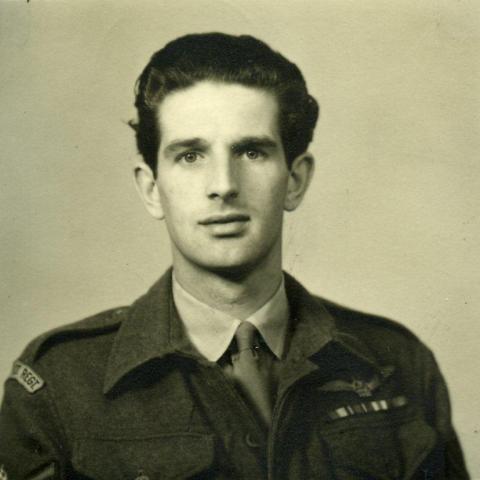
Sydney Neill was born in York in 1921. His mother died when he was only 2 years old and he was brought up in – what were known as – ‘Scattered Homes’ run by Quakers until the age of 7 when he transferred as a boarder to The Bluecoat School.
When he was 12 his father remarried and Syd was taken from The Bluecoat School to live at home and completed his education at a local elementary school leaving at age 14. He went to work at Rowntrees Chocolate Factory, but this kind of life didn’t suit him and he soon left and went to work on a farm on the Yorkshire Wolds, before attempting a career on the Trawlers and then in the Army, joining the East Yorkshire Regiment.
A posting to the 2nd Btn, East Yorks. Regt. followed, where a quick course as drummer and bugler ensued. A ‘Distinguished’ in Maths in the Army Education Certificate allowed a transfer to the Royal Army Pay Corps in May 1939. Eager to see action Syd opted to transfer back to the East Yorks and promptly headed to France, only to be evacuated back to the UK via Cherbourg.
During 1941 Syd made many applications for transfer to the R.A.F. as pilot, navigator, rear gunner and for Special Services Commando and Mercantile Anti Aircraft – all to no avail. Escaping from the Battalion proved difficult until Nov. ’43 when an A.C.I.. called for more Glider Pilots and COs could not stop applications.
Having passed aircrew selection Syd was then sent to Fargo Camp. Initial training was intended to break the spirit, but he survived the ordeal known to all G.P.s and proceeded to EFTS Booker for the next phase of pilot training. It was at this time that he made a life-long friend of another trainee called Fred Tilley. Flying Tiger Moths was a most enjoyable experience, especially side slips and aerobatics. Navigation was his favourite Ground Subject.
Syd was eager for action, however, and this opportunity finally came in the form of Operation Market Garden. His second pilot was Sergeant Jim Robertson, an experienced Glider Pilot with a D-Day landing to his credit. On the tow path that bright Sunday morning his glider, chalk no. 210, was placed second for take-off. The main occupants were Colonel Barlow (2nd I/C Airlanding Brigade and Town Commndant designate) his assistant and interpreter Lieutenant Commander Jan Wolters of the Dutch Royal Navy, a Senior Medical Officer, Brigade H.Q. staff plus a jeep.
Operating under Lt Pickwoad, Syd took part in patrolling operations in Ooterbeek and later was issued with a sniper rifle and took up position in the Kings Own Scottish Borderers lines. As the situation became untenable the troops muffled their boots with cloth and proceeded to follow the taped white lines in the darkness, holding the tail of the smock of the soldier in front.
There was light rain falling as Syd passed the house of Kate Ter Horst and looking up he could see the low cloud as the star shells came over, these two lines of glowing shells in two parallel lines formed the direction to the river.
Arriving at a meadow by the Rhine at about 10.30pm Syd was to wait, with others, in two lines at right angles to the river bank whilst the walking wounded came past in an orderly manner to take their places in the boats. The wait was to be about 4 hours but watching a train burn through from end to end, on the raised track one mile to the east and the continual star shells through low cloud, helped pass the time The small boat operators ferrying the troops did a marvellous job and Syd finally landed unscathed on the other bank where the Military Provost had put down white tape in the direction of the road.
Syd travelled to Brussels by road transport and from there to the UK by air, and eventually back to Blakehill Farm. Lieutenant Pickwoad assembled the remnants of 14 Flight to confirm casualties and prisoners – this being 40-50% of total force.
Next, Syd volunteered for the invasion of Malaya along with other survivors of 14 Flight. The destination was India to form 668/9/70 Sqdns. 343 Wing. Pilots were flown to India occupying any spare seat in any aircraft going East. Syd and a few others left Lyneham in an Avro York, stopping in Sardinia, at El Adem, Cairo, Sharjah and landing at Karachi.
It was now time for the jungle course. The course was run by a Major of ‘V’ Force and a lady anthropologist. About Six Naga headhunters were in attendance controlled by the lady, who spoke their language. The camp was situated near Tiki and well away from any inhabitants, approached alongside a stream where Syd noticed monkey limbs hung for cooking and smoking! Each day it was training for survival, demonstrating the various uses of bamboo such as cooking, making twine, setting traps for men and animals and shelters.
Before seeing further action, the war ended in Europe and the Far East and the chance of any more action was zero. Syd returned to Blighty by the Royal Mail ship the Durban Castle.
Demobbed in March 1946, Syd was recalled to service shortly thereafter as he still, according to Army Records, had one more years service due! Syd, therefore, rejoined the Army at Netherhavon and served his additional year with the GPR.
Syd was demobbed for the second time in May ’47 but a short stay in civvy street was enough, so, back to Fargo in Oct ’47 having signed on for 22 yrs. In Jan ’48 he was again with ‘N’ Squadron, flying hours were – as always – hard to come by logging only 26 hours to the end of October. Then a change of scenery with a posting to R.A.F. Schleswigland.
In March ’49 Syd was informed that he was being transferred back to the East Yorks Regt. – that seemed a let down so he elected to purchase his discharged from the Army.
After leaving the Army Syd did a variety of jobs and after further study at night school he passed the first part of the Intermediate Exam of the Institute of Cost & Works Accountants and became Office & Accounts Manager, before forging a career in the building trade.
Syd found plenty of work to keep him employed until he was 73. Then he decided to retire, and moved back to Devon to be near his family. Syd was the Glider Pilot Regiment Association Standard Bearer for many years.
Syd Neill died in September 2003.
Courtesy of Mike Peters and Jo Hook